For a complete and up-to-date list of all publications and citation metrics, please visit Adrián Granada’s Google Scholar profile.
Since starting our research group in 2020
-
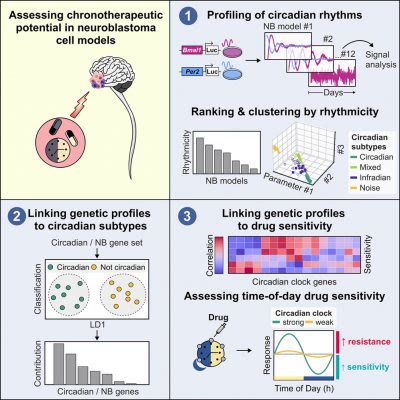
Circadian rhythm heterogeneity modulates drug response variations in neuroblastoma models
Cell Reports (2026) 45
-
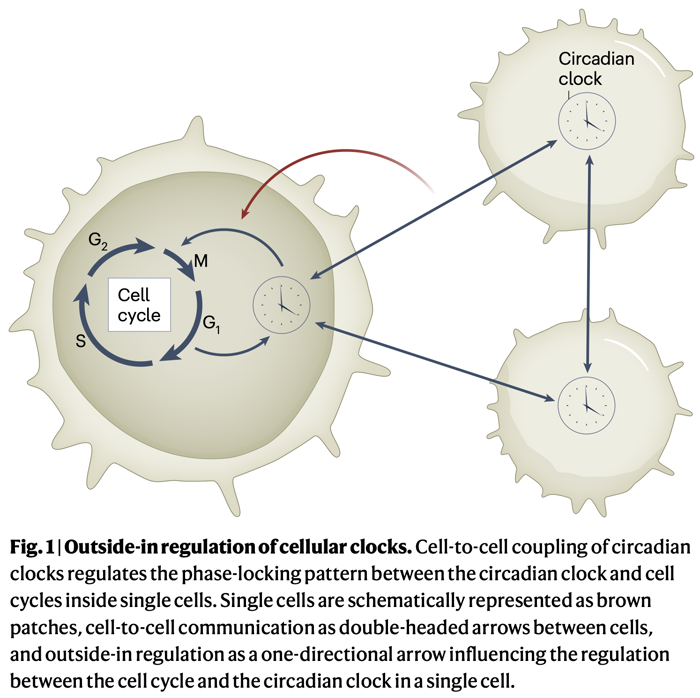
Circadian coupling orchestrates cell growth
Nature Physics (2025)
-
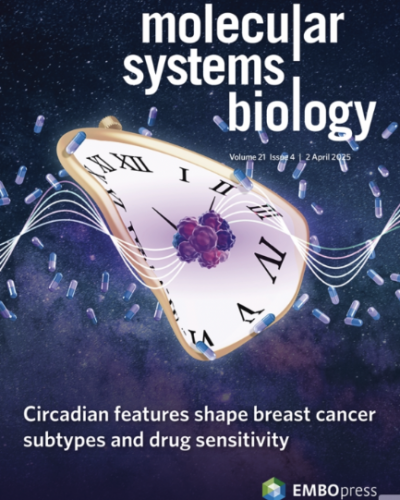
Circadian clock features define novel subtypes among breast cancer cells and shape drug sensitivity
Molecular Systems Biology (2025) · Featured on the cover
-
A combined mathematical and experimental approach reveals the drivers of time-of-day drug sensitivity in human cells
Communications Biology (2025)
-
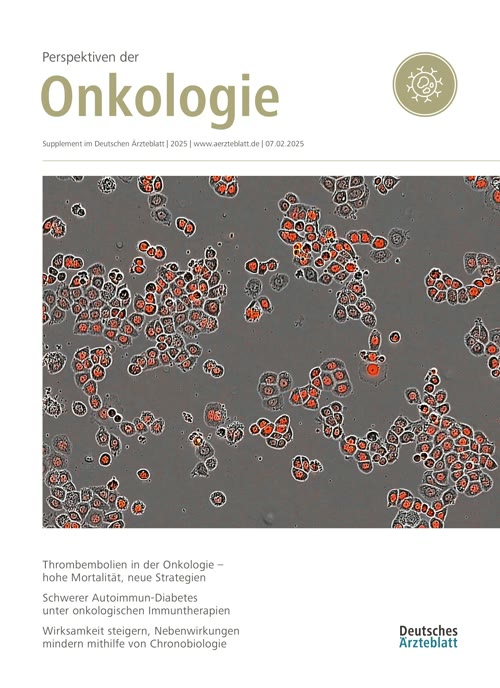
Onkologische Therapien am besten zur individuell optimalen Tageszeit
Deutsches Ärzteblatt (2025) · Perspektiven der Onkologie · Featured on the cover
-
Time-of-day effects of drugs revealed by high-throughput deep phenotyping
Nature Communications (2024)
News articles about our work
-
Circadian period is compensated for repressor protein turnover rates in single cells
PNAS – Proceedings of the National Academy of Sciences (2024)
-
Circadian coupling orchestrates cell growth
Preprint, bioRxiv (2024)
-
Time-of-day effects of drugs revealed by high-throughput deep phenotyping
Preprint, bioRxiv (2024)
-
p53 and p21 dynamics encode single-cell DNA damage levels, fine-tuning proliferation and shaping population heterogeneity
Communications Biology 6, 1196 (2023)
-
Analysis of complex circadian time series data using wavelets
Circadian Regulation: Methods and Protocols, 35–54 (2022)
-
Intercellular coupling between peripheral circadian oscillators by TGF-β signaling
Science Advances 7(30), eabg5174 (2021)
-
Live-cell imaging of circadian clock protein dynamics in CRISPR-generated knock-in cells
Nature Communications 12(1), 3796 (2021)
-
Optimal time frequency analysis for biological data – pyBOAT
Preprint, bioRxiv (2020)
-
The effects of proliferation status and cell cycle phase on the responses of single cells to chemotherapy
Molecular Biology of the Cell 31(8) (2020)
Before the Granada Lab (prior to 2020)
Information transfer in the mammalian circadian clock
Information- and Communication Theory in Molecular Biology, Lecture Notes in Bioengineering. Springer (2018)
Tuning the phase of circadian entrainment
Journal of the Royal Society Interface 12(108) (2015)
Genetic redundancy strengthens the circadian clock leading to a narrow entrainment range
Journal of the Royal Society Interface 10(84):20130221 (2013)
Human chronotypes from a theoretical perspective
PLoS One 8(3):e59464 (2013)
How coupling determines the entrainment of circadian clocks
European Physical Journal B (2011)
Circadian desynchronization
Interface Focus 1:153–166 (2011)
Transients and bifurcations of the mammalian circadian system: from synchronization to desynchronization mechanisms
Logos-Verlag (2011) · ISBN-13: 978-3-8325-2966-6
Coupling governs entrainment range of circadian clocks
Molecular Systems Biology 6:438 (2010)
How to achieve fast entrainment? The timescale to synchronization
PLoS One 4:e7057 (2009)
Phase response curves elucidating the dynamics of coupled oscillators
Methods in Enzymology 454:1–27 (2009)
The generation of respiratory rhythms in birds
Physica A 371:84–87 (2006)